How to Style Accessories with a Formal Wedding Dress
Table of Contents
- Start with the Dress: Neckline, Fabric and Colour
- How to Choose Jewellery for a Formal Gown
- Best Shoes for Floor Length Formal Dresses
- Black Tie Wedding Guest Dress Code: What Accessories Are Appropriate
- Bags, Clutches and Evening Bags That Work with Formal Gowns
- Hair Accessories and Styling Tips for a Polished Finish
- Comfort-First Styling: How to Stay at Ease All Night
- Common Accessory Mistakes to Avoid with Formal Wedding Dresses
- Frequently Asked Questions
Last Updated: September 22, 2026
Start with the Dress: Neckline, Fabric and Colour
Learning how to style accessories with a formal wedding dress starts with the gown, not the jewellery box. Neckline, fabric and colour set the rules for everything else, at Style Me Up, we see the same earrings look wrong on one gown and perfect on another purely because the neckline changed.
Here is how each dress detail shapes your choices:
- Neckline: High necks suit drop earrings. Plunging necks suit pendants.
- Fabric: Shiny satin calls for simple, smooth accessories. Textured lace can handle more detail.
- Colour: Match your metals to the gown's undertone, not just its surface shade.
How to Choose Jewellery for a Formal Gown
Choosing jewellery for a formal gown means picking pieces that frame the dress rather than fight it. The gown is the main event; jewellery supports it.
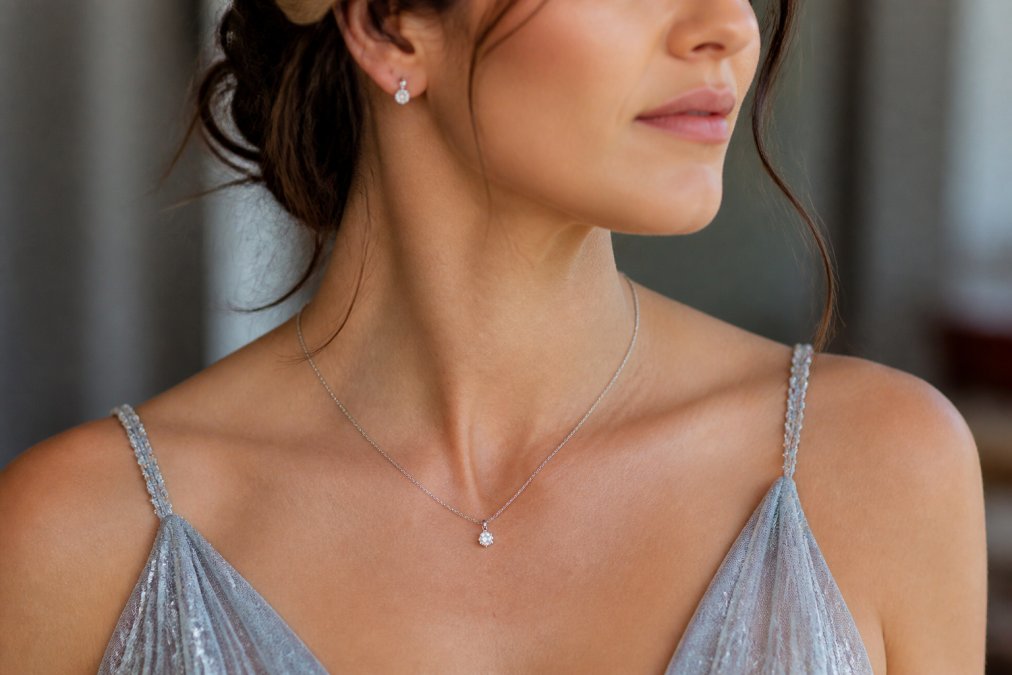
Necklace Rules by Neckline
Match your necklace to your neckline and you will rarely go wrong:
- Sweetheart or strapless: A pendant or short drop necklace fills the open space. Aim for a drop that ends 2-3 cm above the fabric line so it doesn't disappear into the bodice.
- V-neck or plunge: A Y-shaped or long pendant follows the line of the dress. The pendant should sit at the deepest point of the V, not below it.
- High or halter neck: Skip the necklace. Wear drop earrings instead. A high neck already frames the face, so earrings do the work.
- Off-the-shoulder: A choker or short collar sits perfectly above the fabric line. Keep it snug so it doesn't slide onto the sleeve.
- Square neck: A short, structured necklace echoes the clean angles. A geometric pendant or a collar with a flat edge works best.
- Illusion or sheer neckline: Treat it as a high neck. A delicate chain can sit over the sheer panel, but anything heavy will pull the fabric.
Statement vs Minimal: Getting the Visual Balance Right
Balance is the whole game: one bold piece plus quiet pieces beats three loud pieces every time. The more detail on your dress, the less you need on your body.
- Heavily embellished gown: Minimal jewellery, maybe just earrings. If the beading catches light, skip the necklace entirely.
- Plain, clean gown: You can carry a statement necklace or cuff. A single sculptural piece adds interest without clutter.
- Textured fabric: Smooth metal jewellery, no competing sparkle. Brushed gold or matte silver reads as intentional.
- Shiny satin: Matte or brushed finishes to soften the shine. High-polish metals double the glare and look harsh in photos.
Scaling Jewellery to Your Frame and Height
Jewellery size should scale to your body, not just your dress: a statement earring that looks bold on a petite frame can look lost on a taller one.
- Petite frames (under 160 cm): Choose finer chains and smaller drops. A 2 cm drop earring reads as a statement; a 5 cm chandelier can overwhelm.
- Average height (160-170 cm): You can carry most standard statement pieces. A 3-4 cm drop is the sweet spot for earrings.
- Taller frames (over 170 cm): Scale up. A 5-6 cm drop or a wider cuff balances the longer line of the body.
- Broad shoulders: Avoid wide collars that extend past the shoulder line. A longer pendant draws the eye down and inward.
- Narrow shoulders: A collar or short statement necklace adds width and balances the silhouette.
Metal and Gemstone Choices by Dress Colour
Match your metals to the gown's undertone, not just its surface shade. This is the step most people skip, and it's why some jewellery looks 'off' without anyone being able to say why.
- Warm undertones (ivory, cream, champagne, blush): Gold, rose gold and warm-toned pearls.
- Cool undertones (pure white, silver-grey, icy blue): Silver, platinum and white gold.
- Neutral undertones (taupe, greige, soft black): Either metal works, but stay consistent across jewellery, bag hardware and hair pins.
- Bold colours (emerald, sapphire, ruby): Let the dress be the colour. Choose clear stones or plain metal so you don't create a colour clash.
Best Shoes for Floor Length Formal Dresses
The best shoes for floor length formal dresses are comfortable block heels or strappy sandals in a shade that matches or closely echoes your gown. Because the hem hides most of the shoe, comfort matters more than visibility.
A few practical picks:
- Block heels: Stable on grass, carpet and dance floors. The Chanel Gold Heels pair metallic gold leather with a modern square toe and a comfortable block heel, which suits weddings, galas and black-tie events.
- Slingbacks: Easy to slip on and off, and kind to wider feet. The CHANEL Beige Goat Skin Slingbacks offer all-day wearability with a contrasting black cap toe.
- Strappy sandals: Light and elegant, but check the strap does not rub.
Black Tie Wedding Guest Dress Code: What Accessories Are Appropriate
The black tie wedding guest dress code calls for floor-length gowns and refined, understated accessories, no chunky costume jewellery or casual bags.


For black tie, stick to:
- Fine jewellery: Real or high-quality gemstone pieces over plastic or oversized styles.
- A small evening bag: A clutch or structured mini bag, never a tote.
- Elegant heels: Closed-toe or strappy, in a neutral or metallic shade.
- Minimal hair pieces: A simple clip or pin, not a full tiara unless it is your own wedding.
Bags, Clutches and Evening Bags That Work with Formal Gowns
The right bag for a formal gown is small, structured and easy to hold, room for a phone, lipstick and a card. A large bag drags the eye down and breaks the line of a floor-length dress.
A quick guide to matching your bag:
| Gown Style | Best Bag | Why |
|---|---|---|
| Sleek satin | Structured clutch | Keeps the clean line |
| Lace or embellished | Simple smooth clutch | Avoids competing detail |
| Bold colour | Neutral metallic clutch | Balances the palette |
| Minimal gown | Statement clutch | Adds a focal point |
Hair Accessories and Styling Tips for a Polished Finish
Hair accessories should support your hairstyle, not compete with your jewellery. If your ears are the focus, keep hair simple; if your neck is bare, add more detail up top.
Simple options that always work:
- Hair pins: Pearl or crystal pins for a soft, romantic finish.
- Headbands: A slim metallic band suits sleek updos.
- Clips: Good for holding a half-up style without bulk.
Comfort-First Styling: How to Stay at Ease All Night
Comfort is not the enemy of style, the most elegant guest is usually the one not fidgeting with a slipping strap or aching shoes. Here are the fixes that work.
Shoe Comfort: The Mechanics and the Fixes
A block heel is more stable than a stiletto because the wider base distributes pressure, but even a block heel hurts if the fit is wrong. What helps:
- Heel height: A 5-7 cm heel is the practical ceiling for most people standing for four or more hours. Above that, the calf muscle stays shortened and the ball of the foot takes the load.
- Toe shape: A square or rounded toe gives your toes room to spread. A pointed toe compresses them and is the most common cause of late-night pain.
- Inserts: A gel ball-of-foot cushion takes pressure off the metatarsals. A heel grip stops the foot sliding forward, which is what causes toe pinching.
- Breaking in: Wear your shoes indoors for two separate one-hour sessions before the event. This softens the sole and reveals any rub points while you can still return them.
- Backup plan: Flat foldable shoes are now common at formal events. A pair in your bag is not a style failure; it's insurance.
Jewellery Comfort: Weight, Clasps and Skin
Heavy earrings pull on the earlobe and can cause headaches by night's end. The fix is choosing statement earrings that distribute weight well.
- Weight distribution: A wide earring back or a clip-on with a padded pad spreads the load. A thin hook concentrates it on one point.
- Clip-ons: Modern clip-ons with silicone pads are far more comfortable than the old metal ones. Look for adjustable tension.
- Necklace clasps: A lobster clasp is easier to manage than a tiny spring ring, especially if you're dressing alone. A magnetic clasp is even easier but check it holds securely.
- Metal sensitivity: If you react to base metals, stick to sterling silver, gold, platinum or surgical steel. A clear nail polish coat on the post is a temporary fix, not a solution.
Hair and Headwear Comfort
A hairstyle that survives the ceremony but fails by the reception is usually caused by weight and slippage.
- Heavy hair accessories: A large crystal clip or tiara adds weight that pulls the style down. If you want volume, use lightweight pins and let the hair itself do the work.
- Slippery hair: Fine or freshly washed hair holds pins poorly. Day-old hair or a light texturising spray gives pins something to grip.
- Headbands: A slim metal band can dig in behind the ears. Look for one with a fabric or silicone lining.
- Veils: If you're wearing a veil, the comb should sit flat against the head, not on top of a bun. A flat comb distributes pressure and stays put.
The Emergency Kit That Actually Gets Used
- Blister plasters: For shoe rub, not just blisters. Apply at the first sign of rubbing.
- Clear nail polish: For a run in hosiery or a loose bead.
- Safety pins: For a strap that gives way or a hem that drops.
- Fashion tape: For a neckline that gapes or a strap that slips.
- Plasters for jewellery: A small plaster behind an earring back can stop a heavy earring from pulling.
- Mini deodorant wipe: For a long night of dancing.
For anyone hiring a gown, comfort starts with fit: a well-fitted dress needs fewer adjustments and lets you move freely. If you're between sizes, size up and have it taken in.
Common Accessory Mistakes to Avoid with Formal Wedding Dresses
Most accessory mistakes come down to overdoing it. The most common, and their fixes:
- Too many focal points: One statement piece only. Fix: remove one item before you leave.
- Clashing metals: Mixing warm and cool tones without intent. Fix: pick one metal family.
- Wrong bag size: A big bag ruins a formal line. Fix: downsize to a clutch.
- Ignoring the neckline: A necklace that fights the dress. Fix: follow the neckline rules above.
- Uncomfortable shoes: Pain shows on your face. Fix: prioritise block heels.
- Over-accessorising the hair: Competing with jewellery. Fix: choose one area to shine.
Frequently Asked Questions
How do you choose jewellery for a formal wedding dress?
Start with the neckline. A sweetheart or strapless gown suits a statement necklace or chandelier earrings, while a high neckline works best with studs or a bracelet. Match metal tones to the dress hardware or your skin undertone. If the gown has heavy embellishment, keep jewellery minimal so the dress remains the focal point. For a clean satin gown, you can afford something bolder.
What kind of bag should you carry to a formal wedding?
A clutch or small evening bag is the standard. It should hold only essentials: phone, lipstick, card and keys. Match the bag to your shoe colour or choose a complementary metallic. Avoid large totes or crossbody bags, which break the formal silhouette. A structured clutch in black, nude or metallic works with almost any gown. If your dress is heavily detailed, a plain clutch prevents visual clutter.
Are there specific rules for accessorising a floor-length formal dress?
Floor-length gowns already make a statement, so accessories should support rather than compete. Keep jewellery proportional: a long gown can handle a slightly larger pendant or drop earrings, but avoid multiple bold pieces at once. Shoes should be comfortable enough for standing and dancing, and hemlines often hide them, so prioritise fit over visibility. A clutch and one focal accessory are usually enough.
What accessories are appropriate for a black-tie wedding dress code?
Black tie calls for elegant, understated accessories. Choose fine jewellery such as a pendant, stud earrings or a tennis bracelet. A metallic or neutral clutch and strappy heels or slingbacks in a matching tone work well. Avoid casual pieces like oversized watches, woven bags or chunky platform shoes. If you are unsure, lean towards classic shapes and let the quality of the pieces speak for itself.
Styling a formal gown gets much easier when the dress itself is right. Style Me Up makes that first step simple, with designer dress hire across the country, flexible hire lengths and a relaxed boutique try-on experience on the Central Coast. You can try pieces in person, check the fit and build your full look before the big day. Explore our Australia-wide designer dress hire and find the gown that makes accessorising effortless.


