How to Find Dress Size Online: 2026 Fit Guide
Table of Contents
- Why Online Dress Sizing Goes Wrong (And How to Get It Right)
- What You'll Need Before You Start Measuring
- How to Measure Your Body for Dress Size
- Dress Size Conversion Chart Australia: Reading Labels Across Regions
- How to Read a Brand's Size Chart Before You Order
- Fabric Stretch and Why It Changes Your Size Choice
- Designer Dress Hire Sizing Tips for a Flawless Fit
- Troubleshooting Common Fit Issues
- Frequently Asked Questions
Last Updated: September 17, 2026
Why Online Dress Sizing Goes Wrong (And How to Get It Right)
Most online dress sizing fails for one simple reason: women guess. You pick your usual number, hope for the best, and end up with a dress that gapes at the bust or pinches at the hips. Learning how to find dress size online comes down to three numbers and a tape measure.
The fix is not complicated. It just requires ten minutes and the right approach.
Here is the good news: once you know your bust, waist and hip measurements, you can read any brand's size guide with confidence. This guide walks you through measuring at home, converting between sizing systems, and handling the tricky cases most fit guides skip.
What You'll Need Before You Start Measuring
Gather these four things before you begin. Skipping any one of them leads to inaccurate numbers.
- A soft measuring tape (the flexible kind used for sewing)
- A full-length mirror
- Light clothing or underwear you'd wear under a dress
- A friend, if you can find one
A fabric tape measure costs very little and beats a retractable builder's tape every time. Metal tapes do not curve around the body, so they give false readings.
Stand up straight with your feet together. Keep the tape snug but not tight. You should be able to slide one finger under it.
If you are measuring alone, use the mirror to check the tape sits level all the way around. A tape that dips at the back adds centimetres to your hip reading.
How to Measure Your Body for Dress Size
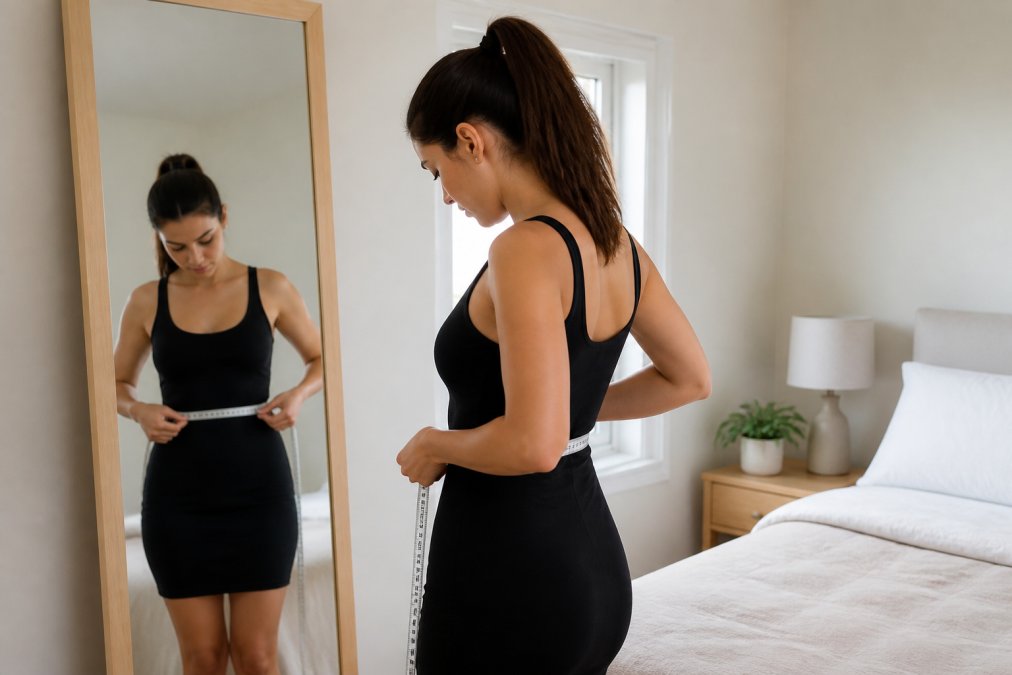
To measure your body for dress size, record three key numbers: bust, waist and hips. Measure over light clothing, keep the tape level, and write each number down in centimetres. These three figures form the basis of every size chart you will read.
Bust, Waist and Hips: The Three Numbers That Decide Everything
Bust circumference is measured around the fullest part of the bust, not under it. Keep the tape level across your back and parallel to the floor.
Natural waistline sits at the narrowest point of your torso. Bend sideways and the crease that forms marks your natural waist. Do not measure across your belly button.
Hip measurement goes around the fullest part of your hips and bottom. This usually sits about 20 centimetres below your waist.
Write all three down in order: bust, waist, hips. This sequence is how size charts list measurements.
Measuring for Specific Dress Silhouettes
Different dress cuts need different numbers. This is the part most guides skip.
- A-line and fit-and-flare: bust and waist matter most. The skirt flares out, so hips rarely cause problems.
- Bodycon and column dresses: all three numbers matter equally. These cuts show every centimetre.
- Empire waist: measure your underbust as well as your bust. The seam sits just below the bust line.
- Off-shoulder and strapless: add your upper bust measurement, taken above the bust and under the arms.
If you are between sizes on a fitted style, size up. A tailor can take a dress in. Letting one out is far harder.
Dress Size Conversion Chart Australia: Reading Labels Across Regions
A dress size conversion chart Australia shoppers can rely on maps your measurements across local, UK, US and EU sizing. The same body can be a different number in each system, which is why charts beat labels every time.
| Your Measurements (bust-waist-hips, cm) | AU Size | UK Size | US Size | EU Size |
|---|---|---|---|---|
| 80-62-88 | 6 | 6 | 2 | 34 |
| 85-67-93 | 8 | 8 | 4 | 36 |
| 90-72-98 | 10 | 10 | 6 | 38 |
| 95-77-103 | 12 | 12 | 8 | 40 |
| 100-82-108 | 14 | 14 | 10 | 42 |
| 105-87-113 | 16 | 16 | 12 | 44 |
How to Read a Brand's Size Chart Before You Order
Reading a size chart properly means matching your measurements to the brand's numbers, not your usual size. Find the row where your bust, waist and hips sit closest to the listed figures. Then check whether the brand measures the body or the garment.
Look for these details on every chart:
- Whether measurements are in centimetres or inches
- Whether the chart covers body or garment measurements
- Whether the brand offers a curve collection or plus size range with separate numbers
- Whether the chart includes a fit guide note about stretch
When Your Measurements Fall Between Two Sizes
Between sizes? Match the size to your largest measurement for fitted styles. For loose or relaxed cuts, match your middle measurement instead.
Here is a general rule:
- Fitted bodice, structured fabric: size up to your largest measurement.
- Stretch fabric, bodycon cut: size down if your bust is the largest number.
- Loose or oversized cut: match your waist measurement.
Fabric Stretch and Why It Changes Your Size Choice
- No stretch (0% elastane): taffeta, satin, crepe, linen, structured cotton. The garment will not give. Order your true measured size, and if you are between sizes, size up. There is no recovery margin.
- Low stretch (1-3% elastane): most lined occasion dresses, ponte, some scuba. Expect roughly 1-2 cm of comfortable give at the bust and waist. You can usually stay at your measured size rather than sizing up.
- Medium stretch (4-8% elastane): jersey blends, stretch crepe, ponte roma. Expect roughly 3-5 cm of give. If you are between sizes, sizing down one is usually safe.
- High stretch (10%+ elastane or elastane-free knits): rib knit, heavy jersey, bodycon knits. These mould to the body and can absorb 6 cm or more. Your usual size will almost always work, and sizing down is rarely necessary.
If the listing does not state fabric composition, treat it as no-stretch and size to your largest measurement. That is the safer default.
Designer Dress Hire Sizing Tips for a Flawless Fit
Hiring changes the sizing maths slightly. You are not committing to one dress forever, so use the flexibility to your advantage.
- Measure yourself fresh before each hire. Bodies shift with training, travel and time of year.
- Ask about the specific dress's fit. Labels run differently, even within one designer.
- Book a try-on where you can. Seeing a dress on your body beats any chart.
- Check the hire window. A dress that arrives early gives you time to swap if needed.
Troubleshooting Common Fit Issues
Most fit problems trace back to one measurement. Here is how to fix the common ones.
| Problem | Likely Cause | Fix |
|---|---|---|
| Gap at the bust | Bust measured too small | Re-measure at fullest point |
| Tight across the back | Tape pulled too tight | Re-measure with one finger of slack |
| Waistband digs in | Waist measured over clothing | Measure over light layers only |
| Hips feel tight | Hip measured at wrong height | Measure 20cm below waist |
| Dress too long | Height not checked | Check model height on the listing |
Frequently Asked Questions
How do I find out what my dress size is?
Start with a soft measuring tape and measure your bust at the fullest part, your natural waistline at the narrowest point, and your hips at the widest part. Write all three numbers down in centimetres. Then compare them against the specific brand's size chart, not a generic one, because sizing varies between labels. If your measurements span two sizes, size up for woven fabrics and consider your body shape when deciding.
Why do dress sizes vary so much between brands?
There is no single enforceable sizing standard across Australian fashion labels, so each brand develops its own fit block based on its target customer and design philosophy. A size 12 at one label can measure like a 10 or 14 at another. This is why reading the specific brand's size chart, checking garment dimensions, and noting fabric stretch matters more than trusting the number on the tag.
How do I use a size chart when hiring a dress online?
Find the brand's own size chart on the product page and compare it against your bust, waist and hip measurements in centimetres. Pay attention to whether the chart lists body measurements or garment dimensions, as these are different. Check the fabric composition for stretch, read the fit notes, and if you are between sizes, ask the hire service for guidance before confirming your order.
What should I do if my measurements fall between two sizes?
Size up for structured or woven fabrics with little give, and consider sizing down only for stretchy fabrics like jersey or crepe with elastane. Check whether the dress has adjustable features such as a tie waist or wrap style that can accommodate a range. For dress hire, mention your measurements when booking so the team can recommend the best fit.
Sizing yourself properly takes ten minutes and saves you from the guesswork that ruins online orders. At Style Me Up, we make that easier with a boutique try-on experience on the Central Coast, nationwide delivery, and flexible hire windows that give you room to get the fit right. Our team talks you through how each designer runs before you order, so you are never guessing blind. Explore our Australia-wide designer dress hire and find a dress that fits the way it should.

%0AWhat%20You'll%20Need%20Before%20You%20Start%20Measuring%0A%0AHow%20to%20Measure%20Your%20Body%20for%20Dress%20Size%0ABust,%20Waist%20and%20Hips:%20The%20Three%20...)