How to Get a Perfect Fit Online: A 2026 Guide
Table of Contents
- Before You Order: What You'll Need for an Accurate Fit
- How to Measure Yourself for a Dress (Step by Step)
- Reading Size Charts Like a Stylist
- Understanding Garment Fabric Stretch (and Why It Changes Everything)
- When Your Measurements Fall Between Two Sizes
- What to Do if a Rented Dress Doesn't Fit
- How to Get a Perfect Fit Online: Practical Tips for Every Body
- Frequently Asked Questions
Last Updated: September 12, 2026
Before You Order: What You'll Need for an Accurate Fit
Getting a perfect fit online starts with two things: a flexible tape measure and a body you measure the same way every time. At Style Me Up, we've watched too many orders go wrong because someone guessed their size from a dress they wore three years ago. The fix is boring, but it works: measure fresh, write it down, and check it against the specific garment's chart before you click order.

Here's what you actually need before you start:
- A flexible tape measure, not a metal builder's tape
- A full-length mirror, or a friend for the awkward angles
- A fitted top and leggings, or underwear, so the tape sits against your body
- A notebook or phone note to record numbers as you go
- The specific size guide for the dress you're considering, not a generic chart
That last point matters more than people think. Sizing is not standardised across labels, and a flexible tape measure is the only tool that follows your actual curves instead of lying flat against them.
That's the setup. Now let's use it.
How to Measure Yourself for a Dress (Step by Step)
Measure yourself in the order below, keeping the tape snug but not tight. If the tape digs in, you're measuring the tape, not your body.
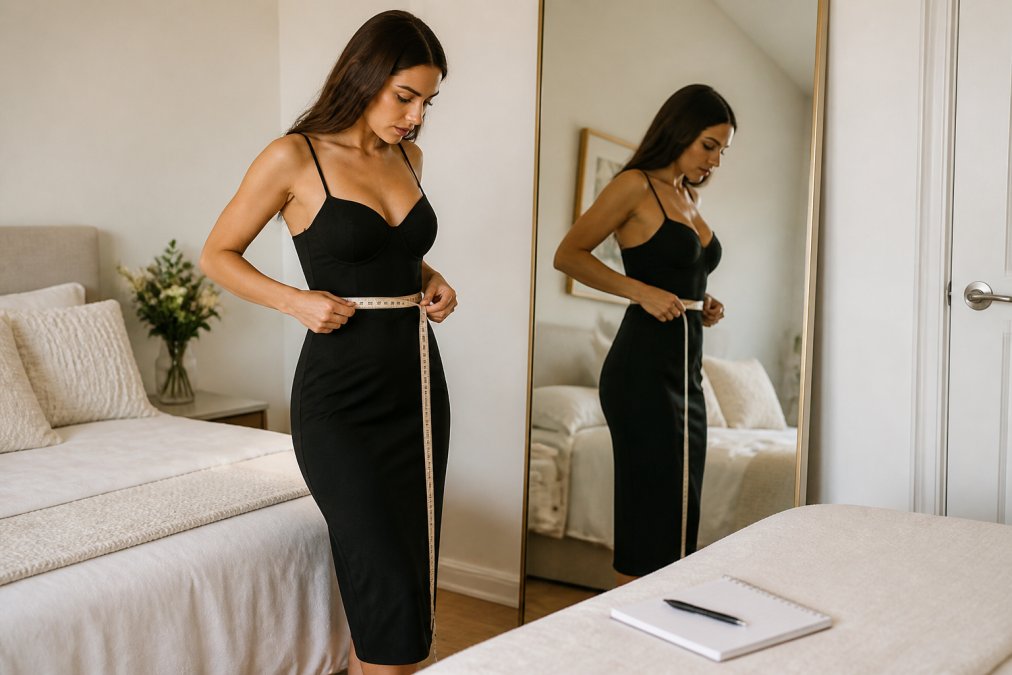
Measuring Bust, Waist and Hips
Bust circumference is measured around the fullest part of your bust, keeping the tape level across your back. Don't pull it tight; you want the tape resting on the surface, not compressing anything.
Waist is the narrowest point of your torso, usually just above your belly button. Bend sideways and the crease that forms is your natural waist. Measure there.
Hips are measured at the fullest point of your bottom, roughly 20cm below your waist (healthdirect.gov.au). Keep the tape parallel to the floor all the way around.
Inseam, Torso and Other Measurements That Matter
Inseam runs from the crotch seam of a pair of well-fitting pants down to where you want the hem to sit. For dresses, torso length matters more: measure from the top of your shoulder, over your bust, down to your natural waist.
For anything strapless or backless, add your upper bust (above the bust, under the arms) and your shoulder width. These two numbers decide whether a dress stays up or needs constant adjusting.
Reading Size Charts Like a Stylist
A size chart is a set of garment dimensions, not a verdict on your body. The number on the tag is a starting point; the measurements are the truth.
Garment Measurements vs Body Measurements
Body measurements describe you. Garment dimensions describe the dress, laid flat, with no one inside it. A size 10 dress does not measure the same as a size 10 body, because the dress has to allow room for you to breathe, sit, and move.
This is where most online shopping goes wrong. People match their body measurement to the garment measurement and end up with a dress that won't zip.
Understanding Ease and Garment Allowance
Garment allowance (or ease) is the extra room built into a dress beyond your body measurements. A fitted evening gown might have 2-4cm of ease at the bust (textileschool.com). A flowing maxi could have 15cm or more.
Different fabrics need different ease. Stiff fabrics need more room to let you sit down. Stretchy fabrics can be cut closer to the body because they give when you move.
Understanding Garment Fabric Stretch (and Why It Changes Everything)
Fabric stretch is the single biggest variable most size guides ignore. Two dresses with identical measurements can fit completely differently depending on what they're made of. A structured crepe with no give will expose every measurement mismatch, while a jersey blend with 5% elastane forgives a centimetre or two.
Here's how to read fabric like a stylist:
| Fabric Type | Typical Stretch | Fit Tolerance | Best For |
|---|---|---|---|
| Structured crepe, satin | None to minimal | Tight, exact sizing | Black-tie gowns |
| Woven with elastane | Moderate | 1-2cm either way | Cocktail dresses |
| Jersey, scuba knit | High | 3-5cm either way | Bodycon styles |
| Chiffon, tulle overlays | None (but draped) | Forgiving through drape | A-line and floaty styles |
The drape of a fabric matters as much as its stretch. A fluid silk will skim over your silhouette; a stiff taffeta will hold a shape regardless of what's underneath. If you're between sizes, choose the stretchier fabric in the smaller size, or the structured fabric in the larger size.
When Your Measurements Fall Between Two Sizes
Between sizes? The default answer is size up, then alter down. But that advice only holds if the garment can actually be altered, and that depends on its construction, not its label.
Start by checking the seam allowance. A side seam with 2-3cm of extra fabric inside can usually be taken in by a tailor without leaving visible needle marks. A seam with less than 1cm, or one that has been overlocked and trimmed, gives almost nothing to work with. If you are between sizes and the seam allowance is tight, sizing up will not save you.
Next, look at where the garment is constructed. Some builds are alteration-friendly, others are not:
- Simple side seams, easiest to take in or let out, and the cheapest alteration.
- Princess seams, curved vertical seams that shape the bust and waist. Alterable, but each seam must be adjusted symmetrically or the dress twists.
- Boning and structured bodices, hard to resize because the boning channels are set to a fixed length. Taking in the side seams can pull the bones out of alignment.
- Bias-cut garments, these stretch and settle on the body over time. A bias dress that feels slightly loose on arrival often fits correctly after an hour of wear, so do not alter it immediately.
- Beaded or sequinned panels, any alteration means re-beading by hand, which most tailors will quote separately and which can cost more than the dress.
Fabric behaviour also changes the decision. A woven with no elastane will not give, so if you are between sizes in a structured fabric, size up. A jersey or scuba knit with 3-5% elastane will forgive a centimetre or two, so the smaller size is usually the better fit. A fluid silk will skim rather than grip, which means the difference between sizes is often invisible once the dress is on.
If you are hiring rather than buying, the calculation shifts. You cannot alter a hired dress without permission, so the safer move is to ask the provider which size they recommend for your measurements and whether they hold both sizes in stock. A provider that offers fit feedback before you commit removes most of the between-sizes risk.
One last check: compare your measurements against the garment's flat-lay numbers, not the brand's generic chart. If your bust sits between two sizes but your waist matches the smaller one, choose based on the measurement that is hardest to alter. Waist and bust are the two that matter most; hem length and sleeve length are easy fixes.
What to Do if a Rented Dress Doesn't Fit
A rented dress that does not fit is a time problem, not just a fit problem. You usually have days, not weeks, before the event, so the order of operations matters.
First, do not alter it. Pinning, stitching, taping or steaming a garment you do not own can void the hire agreement and leave you liable for damage (consumer.vic.gov.au). Even a temporary hem fix can leave marks that a provider will charge for.
Second, contact the provider immediately, before the event, and describe the specific fit issue: too tight at the bust, gaping at the back, hem too long. Providers can usually swap a size faster when they know exactly which measurement is wrong. Most reputable services would rather swap your dress than have you return it unworn and unhappy.
Third, check what your agreement actually covers. This is where most renters get caught out, because fit-related returns are treated differently from change-of-mind returns. Before you hire, run the policy through this checklist:
- Does the provider accept returns or exchanges for fit reasons, or only for faulty goods?
- Is there a deadline for reporting a fit issue, and does it fall before your event date?
- Who pays return shipping if you send the dress back?
- Is there a restocking or cleaning fee deducted from your refund?
- Does the provider hold multiple sizes of the same style, or only the one you booked?
- Is there a try-on or fitting option before the hire period starts?
- What is the damage policy if a tailor adjusts the dress with the provider's permission?
If a swap is not possible, a tailor can sometimes make temporary adjustments, but only with the provider's written permission. Ask the provider to confirm in writing what is allowed, and keep that message. Without it, you carry the risk of any damage claim.
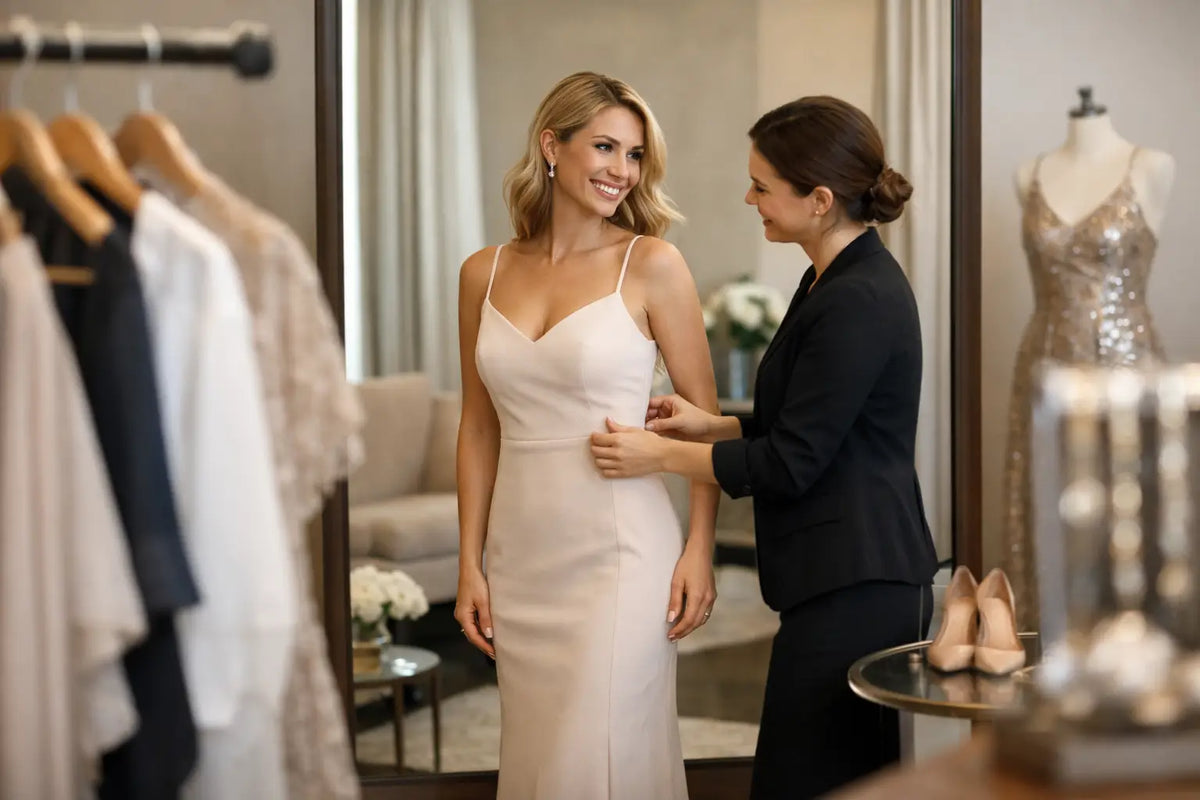
For Style Me Up hires, our team works through fit issues directly, and our Central Coast try-on appointments let you check the fit in person before your event. If you cannot attend in person, send your measurements and the specific fit concern, and ask which size the team recommends. That conversation, held before you commit, is the single most effective way to avoid a fit-related return.
How to Get a Perfect Fit Online: Practical Tips for Every Body
The perfect fit comes down to a repeatable process, not luck. Use this checklist every time you order:
- Measure yourself fresh, in fitted clothing, within a week of ordering
- Record bust, waist, hips, torso, and inseam
- Read the specific garment's size guide, not a brand-wide chart
- Check fabric composition for stretch percentage
- Compare garment dimensions (doubled) against your body measurements
- Account for ease: fitted styles need less, structured styles need more
- Read customer reviews for real-world fit feedback
- Confirm the return or exchange policy before ordering
Body shape matters too. A pear shape and an hourglass with identical hip measurements will fit the same dress differently. Look at where a dress is cut to sit: empire waists suit apple shapes, bias cuts flatter hourglass figures, and A-lines work across most proportions. If you can try before you commit, do it. Style Me Up's try-on appointment service lets you test the fit in person, and our nationwide delivery covers metro and regional areas alike.
Frequently Asked Questions
How do I find my perfect fit when shopping online?
Start by measuring your bust, waist and hips with a flexible tape measure over light clothing. Compare those numbers to the brand's size chart, not your usual size. Check the fabric composition for stretch, read customer reviews about fit, and look for a fit profile or model measurements. If you're between sizes, size up and plan for alterations. A perfect fit comes from matching your measurements to the garment's actual dimensions, not guessing.
What should I do if my measurements fall between two sizes?
Choose the larger size if the fabric has little stretch, then have it taken in at the waist or bust. If the fabric has good stretch, the smaller size may work. Check the garment's allowance: a loose style may fit well in the smaller size, while a bodycon design needs the larger one. For rentals, ask about alterations or exchange options before the event. Always prioritise comfort and movement over the number on the label.
Why is it important to check fabric composition before hiring a dress?
Fabric composition tells you how the dress will behave. Natural fibres like silk and cotton have little give, so you need accurate measurements. Blends with elastane or spandex stretch and may accommodate a range of sizes. Stiff fabrics hold structure and don't forgive fit issues, while soft drape can be more forgiving. Understanding garment fabric stretch helps you predict whether a dress will feel tight, loose or just right.
How can I use customer reviews to gauge the fit of a garment?
Look for reviews that mention the reviewer's height, usual size and whether they sized up or down. Comments like 'runs small' or 'true to size' are gold. Photos from other customers show how the dress drapes on real bodies. If many reviewers with similar measurements to yours say it fits well, that's a strong signal. For rentals, check if the brand shares fit feedback or model measurements to guide your choice.
Finding a dress that fits properly online isn't about luck or a perfect body. It's about measuring accurately, reading the garment's actual dimensions, and knowing how fabric behaves before you commit. Style Me Up takes the guesswork out of it with flexible hire durations, a relaxed boutique try-on experience, and a hassle-free return process, so you can focus on the event rather than the fit. Explore our Australia-wide designer dress hire and find a look that feels made for you.
%0AMeasuring%20Bust,%20Waist%20and%20Hips%0AInseam,%20Torso%20and%20Other%20Measurements%20Tha...)