
Is Dress Hire Actually Sustainable? A 2026 Guide
Table of Contents
- The Real Environmental Impact of Clothing Rental
- Fast Fashion vs Rental Clothing: Which Puts Less Strain on the Planet?
- The Hidden Carbon Cost of Logistics and Dry Cleaning
- Rental vs Buying Second-Hand: Different Paths, Different Trade-Offs
- How to Choose a Sustainable Dress Hire Service
- What Happens to Rented Dresses at the End of Their Life
- Frequently Asked Questions
Last Updated: September 11, 2026
The Real Environmental Impact of Clothing Rental
Is dress hire actually sustainable? The honest answer is that it depends on how the dress gets to you, how it's cleaned, and how many times it's worn before it's retired. We think the industry owes customers a straight answer rather than a green slogan. Clothing rental is a circular economy model: instead of one woman buying a dress she wears once, the same high-quality garment is shared across many events, which spreads its production emissions over far more wears.
What the Lifecycle Numbers Show
Every garment carries embodied carbon from fibre production, spinning, dyeing, cutting and sewing. That cost is paid once, at manufacture. Ownership spreads it across however many times you personally wear the dress, which for occasion wear is often one. Rental spreads the same cost across every hire in the garment's life, so the more a dress is worn, the lower its environmental impact per outing. This is the core of resource efficiency in fashion: use what already exists more intensively before making something new.
Where Rental Saves Emissions and Where It Doesn't
Rental's advantage is real but conditional. It shrinks the number of new dresses manufactured, which is where the bulk of fashion's emissions sit. It loses ground when dresses are shipped long distances individually, dry cleaned after every single wear, or retired early. A hire dress worn fifty times beats a purchased dress worn once on almost any measure. A hire dress worn three times, flown across the country twice and chemically cleaned each time is a much closer contest.
Fast Fashion vs Rental Clothing: Which Puts Less Strain on the Planet?
Comparing fast fashion vs rental clothing comes down to volume, but volume alone doesn't settle it. Fast fashion's model depends on overconsumption: cheap garments, short trend cycles, rapid disposal. Rental's model depends on the opposite, extracting more wears from fewer, better-made garments. The difference is not the fibre; it's the number of times the item is used before it leaves circulation, and, crucially, what it costs to keep it in circulation between wears.
The Cost-Per-Wear Reality
Cost per wear is the metric that ties your wallet to the environmental sustainability question, but it only tells half the story. A $400 dress worn once costs $400 a wear. Hire that same style at around $164 for a single event and you've paid less for the same evening. Buy a $60 fast-fashion dress and wear it three times and you're at $20 a wear, which is cheap, but you've added a short-lived garment to the waste stream. Rental sits in the middle on price and ahead on waste reduction, because the dress keeps working after you hand it back.
The Break-Even Point Nobody Calculates
Here's the angle most guides skip. Rental is not automatically greener than buying, it becomes greener once the emissions saved by not manufacturing a new dress exceed the emissions added by shipping and cleaning the hired one. That crossover is the break-even point, and it moves with three variables: how far the dress travels, how often it's cleaned, and how many times it's worn across its life.
A common pattern looks like this. A dress hired locally, cleaned only when genuinely soiled, and worn forty or fifty times across its rental life will almost always beat a single-wear purchase. A dress couriered individually over long distances, dry cleaned after every single hire, and retired after a handful of outings can approach, or exceed, the footprint of simply buying one dress and wearing it a few times. The manufacture of a garment is the single largest slice of its lifetime emissions, so rental's head start is real; the question is whether logistics and cleaning eat that head start before the dress is retired (europa.eu).
This is why "is dress hire sustainable" has no universal yes. It has a threshold, and the threshold is operational. A provider that consolidates deliveries, batches cleaning, and keeps stock in rotation for years clears the break-even point comfortably. A provider that treats every hire as a standalone courier job may not.
Why This Matters More Than the Fibre Debate
Most fast fashion versus rental comparisons get stuck on materials, organic cotton versus polyester, recycled versus virgin. That debate matters, but it's secondary. A well-made garment worn fifty times will typically out-perform a "greener" garment worn twice, because the emissions from production are paid upfront and never recovered. Rental's real advantage is utilisation, not fibre. Judge a hire service on how hard it works each garment, not on the sustainability language on its label.
The Hidden Carbon Cost of Logistics and Dry Cleaning
This is the part most guides skip, and it's the part that decides whether a hire is genuinely low-impact or just marketed that way. Rental adds two emissions sources that ownership doesn't: shipping emissions and cleaning. Every hire involves transport to you and back, and in a country the size of ours, that can mean long road or air legs. Cleaning is the bigger hidden cost, and it's where the honesty gap in the industry is widest.
What Actually Happens in Industrial Dry Cleaning
Traditional dry cleaning is not dry and it is not water-based. The dominant solvent has historically been perchloroethylene, often shortened to perc, a chlorinated solvent with well-documented health and environmental concerns. It's classified as a probable human carcinogen, it can contaminate soil and groundwater if it leaks or is disposed of poorly, and it persists in the environment. Workers in dry cleaning establishments face the highest exposure, which is why occupational safety regulators take it seriously.
Australian Government guidance on perchloroethylene and dry cleaning
The process also consumes significant energy per garment. Dry cleaning machines run solvent through cycles, then dry and reclaim it, and the whole operation is energy-intensive relative to a simple cold wash. Water usage is lower than laundering in some cases, but the solvent handling, filtration and waste disposal carry their own footprint. A rental business that cleans every dress after every wear, whether or not it was actually soiled, multiplies that footprint across every hire in the garment's life.
The Logistics Side of the Equation
Shipping is the second hidden cost. A dress that travels by road in a consolidated delivery with other garments carries a small per-item footprint. A dress that travels individually, by air, on a next-day service, carries a much larger one. Multiply that by two legs per hire, outbound and return, and the logistics footprint can climb quickly for a single evening's wear.
Explore our Australia-wide designer dress hire →
Packaging matters too. Garment bags, boxes and tissue add up, and reusable or recyclable packaging cuts the per-hire load. The pattern is consistent: the more a provider consolidates and the less it ships per hire, the lower the footprint.
What Good Operators Do Differently
The fix is operational, not theoretical, and it's visible if you know what to ask. Providers that reduce impact tend to share a few habits:
- They clean only when a garment actually needs it, rather than automatically after every hire.
- They batch deliveries and returns into consolidated runs instead of individual courier trips.
- They use reusable garment bags and minimal packaging.
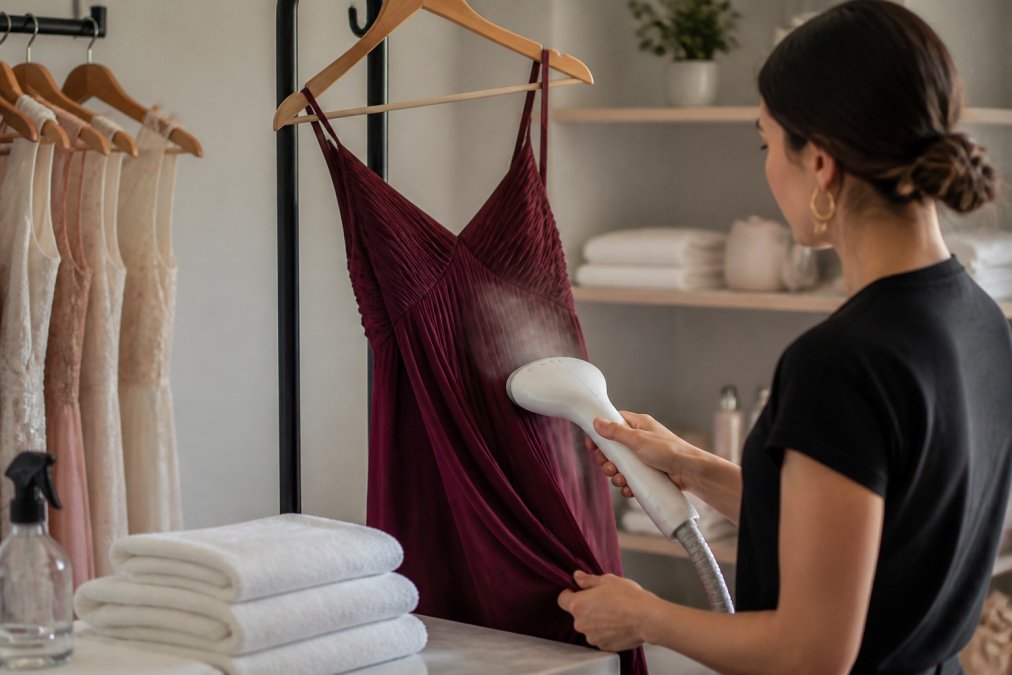
- They spot-clean and steam between hires where the garment allows, reserving full dry cleaning for genuine soiling.
- They keep dresses in rotation for years, so the cleaning and shipping footprint is spread across many wears rather than a few.
When you're assessing a hire service, ask how they clean and how they ship. The answer tells you more than any sustainability badge. A provider that can explain its cleaning intervals and delivery consolidation is usually the one genuinely reducing impact.
Rental vs Buying Second-Hand: Different Paths, Different Trade-Offs
Rental vs second-hand purchasing is the comparison most sustainability articles avoid. Both extend garment longevity, but they suit different people. Buying pre-loved gives you permanent ownership and no ongoing shipping, but you carry the storage, the alterations and the eventual disposal yourself. Rental gives you access to designer fashion and seasonal collections without commitment, at the cost of logistics and cleaning. If you attend one or two events a year and want a specific label, rental usually wins. If you wear the same style repeatedly and have space, second-hand can be the lower-impact choice.
| Factor | Dress Hire | Buying Second-Hand |
|---|---|---|
| Upfront cost | Low per event | Higher, one-off |
| Ongoing shipping | Yes, each hire | None after purchase |
| Cleaning burden | Handled by provider | Yours |
| Storage | None | Yours |
| Access to current designer labels | Yes | Limited |
| Best for | Occasion wear, one-off events | Repeat wear, staple pieces |
How to Choose a Sustainable Dress Hire Service
Knowing how to choose a sustainable dress hire service matters more than any label. Look for providers that stock durable, well-made garments rather than disposable trend pieces, because high-quality garments survive more hires and amortise their footprint. Ask about cleaning methods, delivery consolidation and how long garments stay in rotation. A service that keeps dresses in circulation for years is doing more for landfill diversion than one that refreshes stock every season.
Style Me Up stocks designer labels such as the Herve Leger Strappy Fringe Gown, crafted from recycled yarns, and the Manning Cartell Limitless Halter Knit Dress, made from an Eco-Vero Viscose blend. Both are built to be worn many times over, which is exactly what makes hire work environmentally.


What Happens to Rented Dresses at the End of Their Life
End-of-life garment management is the question rental businesses rarely answer publicly. A dress that's been hired dozens of times eventually shows wear, and what happens next decides whether the model is genuinely circular or just delayed landfill. The best outcomes are resale, donation to community organisations, or fibre recycling where the material allows. The worst is a garment quietly binned once it stops photographing well. Circular economy principles only hold if the loop actually closes.
Australian Fashion Council on circular economy and textile waste
Consumers can push this. Ask providers what they do with retired stock, and favour those with a stated plan. Consumer habits shape what businesses prioritise, and demand for transparency is what turns a marketing claim into practice.
The challenge with dress hire is that sustainability isn't automatic; it depends on logistics, cleaning and how long garments stay in use. Style Me Up approaches this by keeping quality designer pieces in rotation across flexible hire durations, offering nationwide delivery and a boutique try-on experience. If you want to wear designer labels without adding another single-wear dress to the wardrobe, explore our Australia-wide designer dress hire and let us help you find the perfect look.
Frequently Asked Questions
Does renting clothes reduce textile waste in the fashion industry?
Renting extends how long a single garment stays in use. A dress hired out 20 to 30 times replaces up to 30 separate purchases, which keeps that volume of fabric out of landfill. The catch is that rental only reduces waste if the garment is worn many times before retirement. A dress hired twice and then discarded has a worse footprint than one bought and worn regularly. The model works best for occasion wear that would otherwise be worn once.
How does the carbon footprint of dress hire compare to fast fashion?
Rental avoids the production emissions of making a new dress, but adds emissions from shipping and cleaning between wears. Production typically accounts for the largest share of a garment's carbon footprint, so rental usually comes out ahead when a dress is hired repeatedly. Fast fashion's low price encourages frequent buying and short wear life, which drives higher emissions per wear. The gap narrows if a rented dress travels long distances by air or is dry cleaned after every single hire.
Are there hidden environmental costs to dry cleaning rented garments?
Yes, and they are worth asking about. Traditional dry cleaning uses solvent-based processes that consume energy and generate chemical waste, and some solvents are classified as hazardous. Many services now use wet cleaning or greener solvents, which cut both water and chemical use. When choosing a dress hire service, ask how garments are cleaned between hires and whether they use a low-impact method. It is one of the clearest signs of whether a rental business takes its environmental claims seriously.
Is renting a designer dress better than buying second-hand?
Both beat buying new fast fashion, but they suit different needs. Second-hand buying gives you permanent ownership and no shipping between wears, though you may need alterations and the exact size or style can be hard to find. Rental gives access to current-season designer pieces, multiple outfit changes across events, and no long-term storage. If you attend several events a year and want variety, rental wins on cost-per-wear. If you want one versatile dress to keep, pre-loved is often the greener pick.